
Messi vs Ronaldo awards: Ballon d’Or, Golden Shoes and UEFA prizes
Compare Messi and Ronaldo’s Ballon d’Or wins, European Golden Shoes and UEFA awards, with winning years and the counting differences explained.
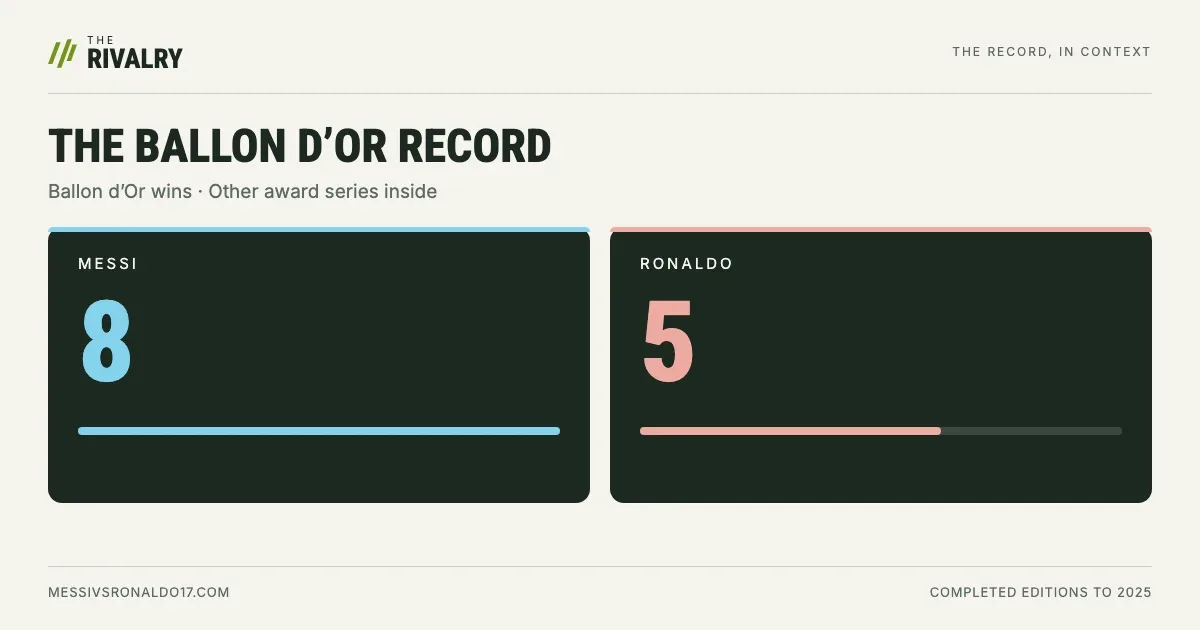
Messi leads the Ballon d’Or comparison eight to five and the European Golden Shoe comparison six to four. Ronaldo leads the UEFA Men’s Player of the Year series three to two. These are separate award records. Combining them into one grand total would hide the different things each prize recognises.
The Ballon d’Or figures below cover completed editions through 2025. This article does not assign a winner to the 2026 edition. The other rows identify their award series explicitly, because a name such as “Golden Boot” or “best player” can describe several different prizes.
Three questions, three award records
Award series | Messi | Ronaldo |
|---|---|---|
Ballon d’Or, completed editions through 2025 | 8 | 5 |
European Golden Shoe | 6 | 4 |
UEFA Men’s Player of the Year / Best Player in Europe | 2 | 3 |
The Ballon d’Or record is supported by UEFA’s complete winners list. Barcelona records Messi’s sixth European Golden Shoe, while La Liga documents Ronaldo’s fourth. UEFA explains the boundaries of its own player-of-the-year series.
Ballon d’Or: the winning years
Messi’s eight winning editions are 2009, 2010, 2011, 2012, 2015, 2019, 2021 and 2023. Ronaldo’s five are 2008, 2013, 2014, 2016 and 2017. Those dates show how the rivalry developed more clearly than a single eight-to-five graphic.
The editions from 2010 to 2015 were presented as the FIFA Ballon d’Or. They remain part of the Ballon d’Or sequence; they should not be counted again as an additional set of trophies when describing that sequence. No Ballon d’Or was awarded in 2020.
Use the Ballon d’Or timeline to inspect the editions. For a question specifically about 2026, the award-process guide is the relevant page, rather than treating an upcoming edition as an extra career win.
European Golden Shoes are scoring awards with a specific scope
Messi’s six came in 2009/10, 2011/12, 2012/13, 2016/17, 2017/18 and 2018/19. Ronaldo’s four came in 2007/08, 2010/11, 2013/14 and 2014/15.
The European Golden Shoe evaluates scoring in European domestic leagues using competition weights. It is not the same as winning a World Cup Golden Boot, finishing as Champions League top scorer or leading one domestic league’s scoring chart. Those achievements can overlap in a season, but their eligibility and competition coverage differ.
That is why “Messi vs Ronaldo Golden Boots” needs a defined award before it needs a number. If you mean the European prize, six to four is the comparison in the Golden Shoe record. If you mean every top-scorer honour from every tournament, that requires a different inventory.
Why UEFA comparisons sometimes show four to three
The UEFA award series introduced in 2011 was initially called Best Player in Europe and later Men’s Player of the Year. Within that series, Messi won for 2010/11 and 2014/15. Ronaldo won for 2013/14, 2015/16 and 2016/17.
UEFA’s earlier Club Footballer of the Year award is a separate predecessor. Ronaldo won that in 2008 and Messi in 2009. Include those earlier prizes and the combined historical count becomes four for Ronaldo and three for Messi. Restrict the comparison to the series introduced in 2011 and it is three to two.
Both presentations can be explained. The problem begins when a graphic uses the later award’s name but silently adds the predecessor’s winners. The UEFA award page keeps the boundary visible.
What is the fairest overall comparison?
Show the award categories side by side and let each answer its own question. A scoring prize, a player vote and a team title are not interchangeable units of football quality. Adding them together gives a number, but it does not supply a reason to value them equally.
For team honours, use the separate trophy register. For individual awards, retain the series names and winning editions. That produces a record readers can check, without asking one oversized total to settle a debate it was never designed to measure.